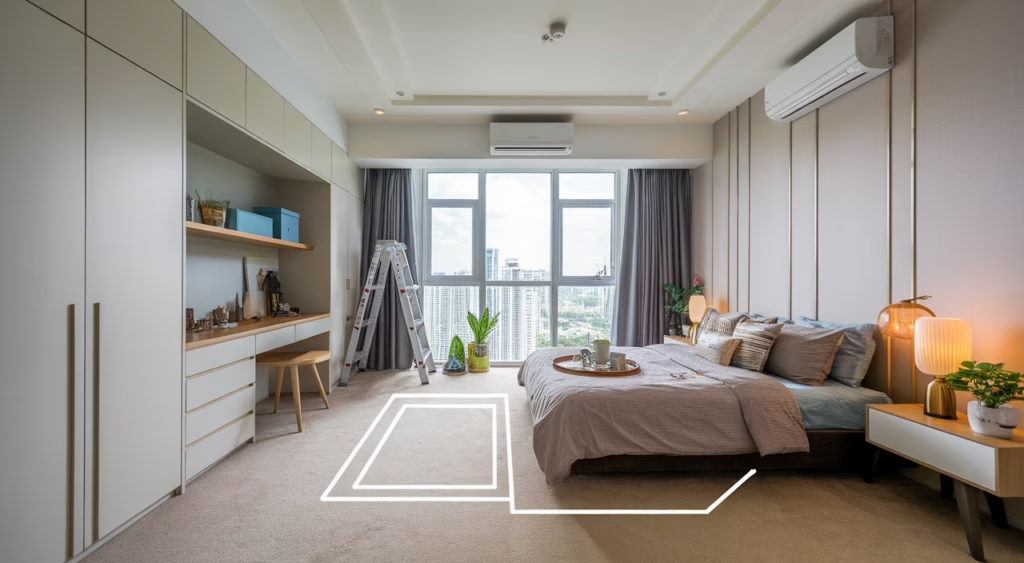
Are you wondering how to navigate aircon trunking installation in your Singapore HDB flat, especially when planning for your master bedroom renovation, or searching for master bedroom aircon unit placement ideas?
As a renovation expert, I can tell you that "aircon trunking" is more than just a conduit; it’s a silent statement about design choices, budget priorities, and functional efficiency in any HDB renovation, often sparking debate and decision-making among homeowners. Understanding its nuances is key to a successful project, ensuring both comfort and aesthetic appeal in your Singaporean home.
The Importance of Aircon Trunking in Renovation: Beyond the Pipes – What it *Means*
For many homeowners in Singapore, the phrase "aircon trunking" carries a dual "meaning." On one hand, it refers to the essential conduits that house your air conditioner system's refrigerant pipes, drainage hose, and electrical wires, protecting them from damage and weather. On the other, it often signifies a necessary aesthetic compromise, a visual element that homeowners strive to conceal or integrate seamlessly. As a renovation expert, I’ve seen this struggle play out countless times in Singapore HDB flats: the desire for an efficient air conditioning system clashing with the wish for a pristine, minimalist interior.
The true "meaning" of aircon trunking in a renovation extends beyond its literal function. It means safeguarding your investment in a quality air conditioner system. Exposed pipes are vulnerable to wear and tear, UV degradation, and accidental damage, which can lead to costly repairs down the line. Proper trunking provides this critical protection, ensuring the longevity and optimal performance of your unit. Moreover, it "means" adhering to safety standards, keeping electrical wires safely tucked away, reducing trip hazards, and preventing potential damage from pests. Ignoring the importance of robust trunking can lead to a host of problems, from refrigerant leaks to electrical faults, all of which compromise your indoor comfort and safety.
The "situations" where "aircon trunking" becomes a central discussion point are typically early in the renovation planning phase. It's when we discuss wall layouts, furniture placement, and overall design aesthetics for areas like the master bedroom. Homeowners often envision sleek, unblemished walls, and the prospect of visible trunking can cause anxiety. This is where a renovation expert steps in to bridge the gap between functionality and design. We explore options like concealing trunking within false ceilings or custom carpentry, or strategically painting it to blend with the wall. The decision on how to manage aircon trunking profoundly impacts the finished look of your home, and understanding its multi-faceted "meaning" from the outset is crucial for a smooth renovation process in your Singapore HDB.
In summary, the "meaning" of aircon trunking isn’t just about hiding pipes; it’s about protecting your air conditioner system, ensuring safety, and making deliberate design choices that reflect your personal aesthetic while maintaining the practical efficiency of your home. It’s an integral part of any comprehensive renovation, especially in the context of Singapore HDB living where space and design considerations are paramount.
Choosing the Right Air Conditioner System for Your Master Bedroom: Understanding the *Tone* of Your Choices
Selecting the ideal air conditioner system for your master bedroom is a decision that sets the "tone" for your comfort and energy consumption for years to come. In Singapore HDB flats, where space can be a premium, this choice is particularly significant. As a renovation expert, I often guide homeowners through the various options, emphasizing that the "tone" you choose – be it one of ultimate luxury, quiet efficiency, or pragmatic cost-effectiveness – will dictate the type of system and, consequently, the complexity of your aircon trunking.
The "tone" begins with system type. For master bedrooms, multi-split systems are overwhelmingly popular in HDBs, allowing a single outdoor compressor unit to power multiple indoor units throughout your home. This approach generally leads to more discreet outdoor aircon trunking runs. Alternatively, a single-split system provides dedicated cooling for just one room, which might simplify the aircon trunking installation in that specific master bedroom, but might not be optimal if you plan to cool other areas later. The choice here sets the overall "tone" for your home's cooling infrastructure.
Next, consider the factors that define the "tone" of your comfort: room size and usage patterns. A larger master bedroom or one with significant sun exposure will require a higher BTU (British Thermal Unit) capacity, conveying a "tone" of powerful, consistent cooling. If you use your aircon extensively, then selecting a system with a high energy efficiency rating (e.g., 5-tick NEA rating in Singapore) will project a "tone" of environmental consciousness and long-term cost savings. The refrigerant type also adds to this "tone." While R410A is still common, R32 refrigerant systems represent a more environmentally friendly "tone," with a lower global warming potential and often higher efficiency, aligning with a forward-thinking perspective.
The "usage" of your air conditioner system also dictates the necessary "tone" of its supporting infrastructure. If your master bedroom is your sanctuary, used daily for long hours, the "tone" of your aircon trunking must be robust, properly insulated, and seamlessly integrated to support this heavy usage without compromising aesthetics or efficiency. Conversely, for occasional use, while quality remains paramount, the immediate "tone" of the system might be more about instant comfort than continuous, heavy-duty performance. By understanding the "tone" you wish to set for your master bedroom's cooling, you can make informed decisions that resonate with your lifestyle and renovation goals, ensuring your air conditioner system and its supporting aircon trunking meet both your practical and aesthetic expectations within your Singapore HDB.
Tips for Optimizing Aircon Placement in Small Bedrooms: Navigating *Misunderstandings* and Practicality

When renovating a Singapore HDB flat, especially a compact master bedroom, optimizing aircon placement requires navigating several common "misunderstandings" while adhering to practical considerations. As a renovation expert, I often encounter homeowners who have preconceived notions about where their air conditioner system "must" go, without fully considering the impact on airflow, efficiency, and the overall aesthetic integration of their aircon trunking. Dispelling these myths is crucial for achieving an optimal setup.
One prevalent "misunderstanding" is that the aircon unit should always be placed directly above the bed. While often convenient for aircon trunking runs, this can lead to uncomfortable drafts directly on occupants, potentially affecting sleep quality. A more practical "usage" of space might involve placing the unit on an adjacent wall, directing airflow across the room, or positioning it in a corner. The goal is even distribution of cool air without direct blasts. Another "misunderstanding" concerns the need for "perfectly concealed" aircon trunking at all costs. While aesthetically pleasing, sometimes the most efficient and cost-effective trunking run might involve a short exposed section. The trick is to make it blend in or appear intentional, rather than an afterthought, leveraging good design rather than hiding everything at exorbitant expense.
Practicality also dictates avoiding obstructions. Wardrobes, tall bookshelves, or heavy curtains can impede airflow, significantly reducing the efficiency of your air conditioner system and increasing energy consumption. For small bedrooms, maximizing cooling means ensuring an unobstructed path for the air. This might mean adjusting furniture layouts or opting for built-in wardrobes that accommodate the aircon unit and its aircon trunking. When planning renovation tips for optimizing aircon placement in small bedrooms, always think about the "usage" of the air – where it needs to go, and what might stop it.
In Singapore HDBs, beam obstructions are a common "situation" that can complicate aircon trunking installation. Rather than fighting them, we often "use" them as opportunities. Trunking can be run along the bottom of a beam, or a false ceiling can be cleverly designed to conceal both the trunking and the beam, creating a cleaner line. Always consider the gradient of the drainage pipe within the aircon trunking; it must have a slight slope to ensure proper water drainage, preventing leaks and potential damage. "Misunderstandings" about this critical detail can lead to serious issues. By approaching aircon placement with a clear understanding of these practicalities and dispelling common "misunderstandings," you can achieve an air conditioner system that is both highly efficient and aesthetically pleasing in your master bedroom, even in the smallest HDB spaces.
Cost-Effective Solutions for Aircon Trunking in Singaporean Homes: The *Variations* and *Responses* to Budget
In the realm of Singapore HDB renovations, "cost-effective aircon trunking solutions" are often a hot topic, inspiring a range of "variations" in design and "responses" from homeowners based on their budget. As a renovation expert, I understand that while everyone desires a seamlessly integrated air conditioner system, the reality of budget constraints often means exploring different approaches to aircon trunking. The key is to find the right balance between aesthetics, durability, and expenditure.
The most significant "variation" in aircon trunking is between exposed and concealed designs. Exposed aircon trunking, typically made of PVC, is the most common and generally the most budget-friendly option. Homeowners’ initial "response" might be apprehension due to aesthetics. However, with careful planning, even exposed trunking can be made to look neat and intentional. Painting the trunking the same color as the wall, running it along ceiling lines or within corners, and ensuring clean, straight runs are simple yet effective strategies. Another "variation" involves using metal casing for trunking, which offers a more premium, industrial look, often at a higher cost. These "variations" cater to different aesthetic "responses" and budget points.
Concealed aircon trunking, achieved by embedding it within false ceilings or custom carpentry, represents a higher-end "variation." The immediate "response" is usually admiration for the clean lines and minimalist look. While this eliminates visible aircon trunking, it significantly adds to the overall renovation cost due to the additional carpentry and false ceiling work. This is where "cost-effective solutions" come into play; perhaps concealing only the most visible sections in the master bedroom, or strategically running exposed trunking in less conspicuous areas. The "response" to this pragmatic approach is often positive, as it balances desires with realistic budgets for a Singapore HDB flat.
Material "variations" also influence cost. Standard PVC trunking is economical and widely used. For specific aesthetic needs, some might explore custom wood casings or other materials, which will have a different cost "response." Furthermore, the complexity of the aircon trunking installation directly impacts cost. Long, winding runs with many bends and turns will naturally cost more in labor and materials than shorter, simpler runs. "Responses" to such complexities often involve re-evaluating the air conditioner system layout or considering alternative unit placements to simplify the trunking path, aligning with the ethos of "cost-effective solutions for Singaporean homes." Proactive planning and clear communication with your renovation expert are essential to navigate these "variations" and ensure your budget "responds" positively to your chosen aircon trunking solution.
Master Bedroom Aircon Unit Placement Ideas for HDB Flats: The *Usage* and *Situations* of Aesthetic Integration
For Singapore HDB homeowners, the master bedroom is a sanctuary, and the "usage" of space within it, especially for a key appliance like an air conditioner system, is paramount. "Master bedroom aircon unit placement ideas for HDB flats" are not just about cooling efficiency; they’re also about integrating the unit and its associated aircon trunking seamlessly into the room's design, considering various "situations" unique to HDB layouts. As a renovation expert, I guide clients to think strategically about how they "use" their master bedroom to inform the best placement.
One common "situation" in HDB master bedrooms is the presence of structural beams, which can present challenges for both unit placement and aircon trunking. Instead of seeing them as obstacles, we "use" them as guides. For example, placing the aircon unit on a wall where its trunking can run along the bottom of a beam or be concealed within a false ceiling that levels with the beam. This "usage" of existing structures helps create cleaner lines. Another "situation" is the limited wall space due to wardrobes or windows. Here, creativity in "usage" is key. Positioning the unit above a built-in wardrobe or a doorway can free up valuable wall space, while ensuring the aircon trunking integrates into the cabinetry or above the door frame.
When considering "usage" for optimal airflow, avoid placing the unit directly above or opposite a window that is frequently opened, as this can lead to energy wastage. Instead, aim for a placement that allows the cool air to circulate evenly throughout the master bedroom, without hitting obstructions immediately. The aesthetic integration, or how the unit "uses" its visual presence in the room, is also critical. Wall-mounted units are standard, but how they are framed by furniture or decorative elements can make a significant difference. "Situations" where the aircon unit and its aircon trunking become a focal point can be softened by painting the trunking to match the wall color, or by incorporating it into a feature wall design.

The "usage" of specific placement ideas can also extend to how they impact the overall "feel" of the master bedroom. For instance, in a long, narrow HDB master bedroom, placing the unit on one of the longer walls can improve air distribution compared to placing it on a shorter end, directly "using" the room's dimensions to your advantage. Ultimately, "master bedroom aircon unit placement ideas for HDB flats" demand a holistic approach, where the functional "usage" of the air conditioner system and its supporting aircon trunking is carefully balanced with the aesthetic "situations" of your unique Singapore HDB layout, transforming potential challenges into design opportunities.
Aircon Trunking Installation, Maintenance, and Longevity in Singapore HDB: Proactive *Usage* and Correct *Responses*
As a renovation expert, I cannot stress enough that the proper "aircon trunking installation guide for Singapore HDB" is paramount not just for immediate efficiency but for long-term maintenance and the longevity of your entire air conditioner system. This section combines crucial aspects of installation and aftercare, focusing on proactive "usage" of best practices and appropriate "responses" to common challenges and needs.
**Installation: Dispelling "Misunderstandings" and Ensuring Proper "Responses"**
One of the biggest "misunderstandings" homeowners have is that aircon trunking installation is a simple task that anyone can do. In reality, it requires skilled professionals. Improper installation, especially concerning the refrigerant piping within the aircon trunking, can lead to gas leaks, reduced cooling efficiency, and premature breakdown of your air conditioner system. HDB regulations for installations and modifications also need to be strictly followed, which can be a complex area for a layman. The correct "response" is always to engage BCA-registered aircon contractors who are familiar with Singapore HDB guidelines and safety standards. They will ensure that mounting brackets are secure, holes drilled for piping are properly sealed to prevent water ingress, and the aircon trunking itself is installed with the correct gradient for drainage.
A critical detail during installation, often "misunderstood," is the quality of insulation within the aircon trunking. Poor insulation leads to condensation, which can cause unsightly water stains on walls, mold growth, and even damage to plaster or paintwork. The correct "response" is to ensure high-quality ½ inch or ¾ inch thick armaflex insulation is used for all refrigerant pipes. Furthermore, all joints in the trunking must be properly sealed to prevent dust and pests from entering, ensuring a clean and efficient "usage" of the system’s internal environment.
**Maintenance and Longevity: Proactive "Usage" for Lasting Value**
Beyond installation, the "usage" of proactive maintenance practices is vital for the longevity of your aircon trunking system and overall air conditioner system. While the aircon unit itself requires regular servicing, the trunking also benefits from occasional inspection. What does this "mean" in practice? Regularly check the visible sections of your aircon trunking for any signs of cracks, discolouration, or gaps. These could indicate wear and tear, exposure to elements, or even pest intrusion. Your "response" should be prompt repair or resealing to prevent further degradation.
Signs of issues, such as water stains on walls below the aircon unit or along the trunking path, "mean" a potential drainage problem or condensation leak within the aircon trunking. The correct "response" is to contact your aircon servicing company immediately. Ignoring such signs can lead to structural damage, mold, and even short-circuiting of electrical components. Cleaning the exterior of your aircon trunking regularly helps maintain its aesthetic appeal and prevents dust accumulation. While the internal pipes are cleaned during aircon servicing, external cleanliness contributes to the overall hygiene and "tone" of your master bedroom and Singapore HDB flat.
The longevity of your aircon trunking system is directly tied to both the initial quality of installation and your commitment to ongoing, proactive "usage" of maintenance. By ensuring a professional installation that adheres to all guidelines and then responding appropriately to any signs of wear or malfunction, you guarantee that your air conditioner system remains efficient, safe, and an integral part of your comfortable Singaporean home for many years.
TL;DR: Navigating Your Aircon Trunking Journey in Singapore HDB
As a renovation expert, I’ve delved deep into the nuances of "aircon trunking" for Singapore HDB homeowners, showing it's far more than just pipes – it's a critical element defining your master bedroom renovation. Here's what you need to know:
- **Understanding the "Meaning":** Aircon trunking isn’t merely functional; it safeguards your air conditioner system, ensures safety, and impacts your home's aesthetics, setting a "tone" for comfort and efficiency.
- **Choosing Your System:** The "tone" of your air conditioner system choice (e.g., multi-split for efficiency) dictates trunking needs, balancing power, and energy efficiency for your master bedroom.
- **Optimizing Placement:** Counter common "misunderstandings" by strategically placing your aircon unit to maximize airflow and avoid obstructions, crucial for renovation tips for optimizing aircon placement in small bedrooms. Consider unique HDB "situations" like beams creatively.
- **Cost-Effective Solutions:** Explore "variations" like exposed or concealed aircon trunking, understanding the cost "responses" associated with each. Smart planning can achieve "cost-effective aircon trunking solutions for Singaporean homes" without sacrificing quality.
- **Placement Ideas:** "Master bedroom aircon unit placement ideas for HDB flats" should prioritize effective air "usage" and aesthetic integration, turning HDB layout "situations" into opportunities.
- **Installation & Maintenance:** This requires a skilled "aircon trunking installation guide for Singapore HDB" expert. Proper insulation and sealing are key. Proactive "usage" of maintenance checks and timely "responses" to issues ensure longevity and prevent costly repairs.
By understanding these multifaceted aspects, you can confidently make informed decisions for your renovation project, ensuring a comfortable, efficient, and aesthetically pleasing living environment in your Singapore HDB flat.

